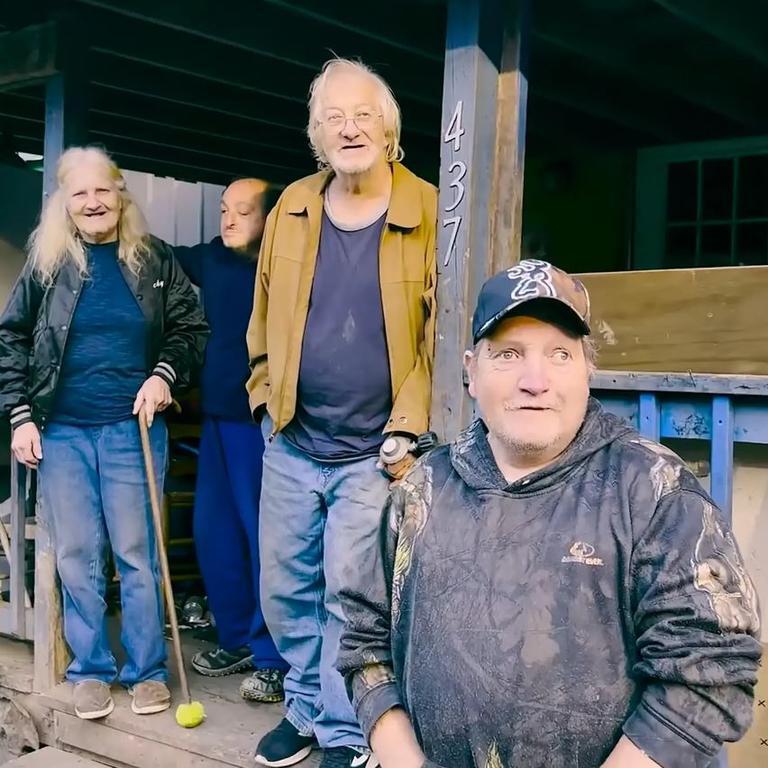
In the heart of a small town secluded Appalachian town, located deep within the rolling hills, lived the enigmatic Whittaker family. For generations, rumors had swirled about this reclusive clan. They were known as the ‘most inbred family’ in America, a label that had hung heavily over them for years. But there was more to their story than the whispers and judgments that had plagued them. This is the remarkable tale of the Whittakers.
The Whittakers’ distinctive form of communication consisted of a series of grunts, gestures, and simple vocalizations that had been passed down through the generations. It was a language that had evolved within the family, born from a desire to preserve their heritage and shield themselves from outside influence. To outsiders, it seemed cryptic and impenetrable, leading to the family’s reputation as ‘inbred’ and ‘strange.’
However, one photographer proved that such communities do in fact exist after documenting the secret lives of the Whittakers — aka “America’s most inbred family”, whose members communicate only in grunts and bark at passers-by. “It was out of control — the craziest thing I’d ever seen” documentarian Mark Laita, 63, recalled recently on the Konkrete podcast. He was describing his first ever encounter with the Whittakers, who reside in the rural mountain town of Odd, West Virginia, which boasts an infamously tight-knit population of around 779 people.
Laita has dedicated a significant amount of time to the notably endogamous Whittaker family, with his first visit dating back to 2009 when he was working on his book “Created Equal.” He had a spontaneous reunion with them last year. He also frequently showcases this rarely glimpsed facet of Appalachian life on his podcast, “Soft White Underbelly,” which specializes in “interviews and portraits of the human condition” for an audience of 4.56 million YouTube subscribers.
According to Thought.Co, a repository of “expert-curated educational content,” consanguinity can result in a range of adverse consequences, including diminished adult stature, decreased fertility, and an elevated susceptibility to genetic disorders. In exceedingly rare instances, it may even manifest as an unusual condition like sapphire-colored skin, as exemplified by the well-known Blue Fugates of Troublesome Creek, Kentucky.
The Whittaker family, however, did not seem to comprehend that their genetic difficulties were a result of intermarriage within their own lineage. When the portraitist inquired why family member Kenneth’s eyes did not align as typical, his response was, “Possibly due to coal mining.
Naturally, Laita’s series might appear exploitative, resembling a sideshow at a carnival. Criticism arose from Melody West and Shane Simmons of the Real Appalachia YouTube channel, accusing the documentary of perpetuating the enduring “stereotype” of inbreeding in the Appalachian region that has persisted “for decades.”
Nonetheless, Laita, who has also been behind the lens for major brands such as Nike and Apple, asserted on the Konkrete podcast that his intention was to illustrate the profound “level of poverty” confronting the Whittaker family.
The photographer initiated a GoFundMe campaign, raising nearly $50,000 of the $75,000 goal to aid the West Virginian family. During a 2022 visit, Ray showcased their newly improved home, highlighting the contributions that furnished a refrigerator and a bed. Laita’s primary aim is to spotlight the often-hidden challenges in certain parts of the country, like the struggles faced by those in Appalachia surviving on meager incomes.
The story of the Whittakers, once known as ‘America’s most inbred family,’ began to change. It was no longer a story of isolation but a tale of love, resilience, and the extraordinary ways a family had preserved their heritage.
As the story of the Whittakers reached a broader audience, it reminded everyone that beneath our differences and peculiarities, there are universal truths that connect us all. The Whittakers’ journey was a testament to the enduring power of love, family, and the desire to protect what matters most, even if it meant living on the fringes of society.