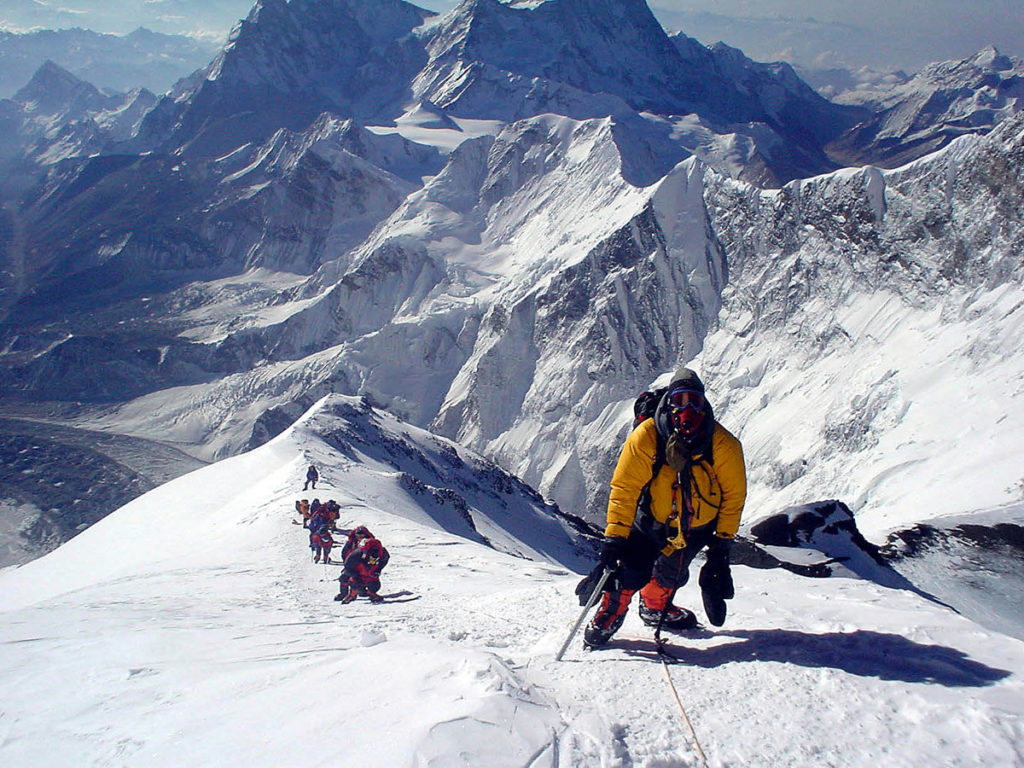
Mount Everest, the highest peak in the world, is located in the Himalayas on the border between Nepal and the Tibet Autonomous Region of China. This iconic mountain stands at a towering height of 8,848.86 meters (29,031.7 feet) above sea level. It is known as “Sagarmatha” in Nepali and “Chomolungma” in Tibetan, both of which mean “Goddess of the Sky.”
Geography and Formation: Mount Everest was formed millions of years ago through the collision of the Indian and Eurasian tectonic plates, which continue to push the mountain higher each year. The region around Everest is characterized by its rugged terrain, deep valleys, and harsh climate, making it one of the most challenging places on Earth to reach.
Climbing Mount Everest: Climbing Mount Everest is a formidable and often perilous endeavor. The two main routes to the summit are the South Col Route from Nepal and the North Col Route from Tibet. Expeditions typically take place during the pre-monsoon and post-monsoon seasons, in April-May and September-October, respectively.
Climbers need to be in peak physical condition and possess significant mountaineering experience to even consider attempting Everest. They must also secure permits and the services of experienced Sherpas, who are indispensable in guiding and supporting climbers throughout the expedition.
Challenges and Dangers:
- Altitude: The extreme altitude poses the most significant challenge. Oxygen levels are only about a third of those at sea level, leading to altitude sickness, frostbite, and exhaustion.
- Extreme Weather: The weather on Everest can be incredibly unpredictable, with fierce winds and sub-zero temperatures. Sudden storms are common and can prove fatal.
- Avalanches and Icefalls: The Khumbu Icefall, a treacherous and constantly shifting section, poses a significant danger. It is prone to avalanches and crevasses.
- Crowds: In recent years, overcrowding on the mountain has become a concern, leading to delays and bottlenecks that can be life-threatening.
Experiences of Climbers: For those who attempt the climb, it is a life-changing and often spiritual experience. Climbers face not only physical but mental and emotional challenges as they push their limits and confront their mortality. The journey demands unwavering determination, perseverance, and courage.
Experiences associated with climbing Mount Everest:
Preparation and Training: Before attempting to climb Mount Everest, climbers typically spend months, if not years, preparing physically and mentally. They engage in rigorous physical training to build strength, endurance, and aerobic capacity. This includes hiking, running, weightlifting, and practicing on other high-altitude mountains to acclimatize.
Mental preparation is equally critical, as climbers must be mentally resilient to cope with the challenges of extreme altitude, isolation, and uncertainty. They often train to manage fear and stress while making split-second decisions that can mean life or death.
The Journey on the Mountain: Climbers typically break their ascent into several stages, setting up base camps at different elevations. These camps serve as rest points and acclimatization stops. Climbers gradually ascend and descend between these camps to allow their bodies to adjust to the thin air and to minimize the risk of altitude sickness.
The Khumbu Icefall, a perilous section of the climb, requires crossing ladders over crevasses and navigating through shifting ice formations. Climbers need to be extremely cautious in this area.
Camp 4, also known as the South Col, is the final camp before the summit push. From here, climbers begin the most challenging part of the journey, the ascent to the summit, typically starting in the middle of the night to take advantage of more stable weather conditions.
Reaching the Summit: Summit day is the culmination of the climber’s efforts. Climbers set out with headlamps, bundled in multiple layers of clothing, and usually using supplemental oxygen. The climb to the summit is grueling, with climbers experiencing extreme cold, fatigue, and exhaustion.
The last stretch, known as the Hillary Step, is a steep and rocky section near the top. Finally, after hours of effort, climbers reach the summit. The experience of standing on top of the world, with the earth below stretching out in all directions, is profoundly moving. They often plant flags, take photographs, and reflect on the significance of the moment.
The Descent: Reaching the summit is only half the journey. The descent can be just as challenging and dangerous as the ascent. Fatigue, lack of oxygen, and the unpredictable weather pose ongoing risks. Many accidents happen during the descent, so climbers must stay focused and make safe choices.
The Impact on Climbers: Climbing Mount Everest leaves a lasting impact on those who undertake the journey. It’s a testament to human determination and endurance. Climbers often speak of a newfound appreciation for life, a deeper connection to nature, and a profound sense of achievement. The experience can be both humbling and empowering, making climbers more resilient and capable in other aspects of life.
The journey of climbing Mount Everest is a life-defining adventure that combines physical and mental challenges with moments of awe, achievement, and self-discovery. While it’s a remarkable achievement, climbers and expedition organizers must prioritize safety and sustainability to ensure the mountain’s preservation for future generations, as over-tourism and environmental issues are growing concerns for this extraordinary natural wonder.