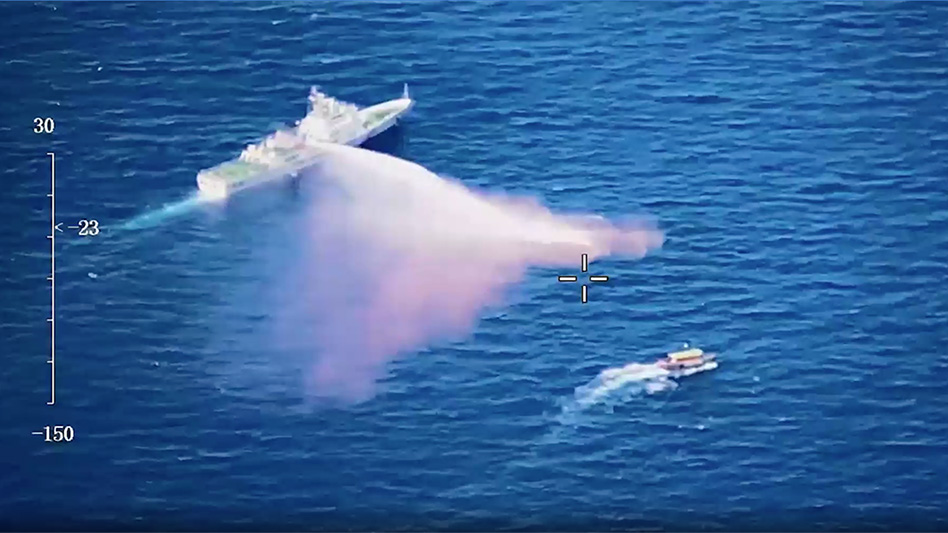
The Filipino fishermen aboard our wooden boats enthusiastically greeted our Philippine fisheries vessel from just a stone’s throw away, yet an ominous stillness permeated our ship. We found ourselves encircled by the imposing presence of two Chinese Coast Guard ships and five Chinese militia vessels.
Then, without warning, the water cannon unleashed its fury.
From one of the Chinese Coast Guard ships, a high-intensity water jet erupted, aimed squarely at our vessel, preventing any attempt to approach the Filipino fishermen near the Scarborough Shoal, an expanse of reefs and rocks situated 140 miles west of the Philippines. The force of the water struck our boat with seismic intensity, rocking it as if caught in the throes of a maritime earthquake. “Emergency!” bellowed Armando Hachuela, the captain of our ship, urgently directing the crew and journalists on deck to seek refuge inside. “Inside, now!” he commanded, as the relentless water assault continued.
As we scrambled for cover inside the confines of the vessel, the deafening roar of the water cannon persisted, creating an atmosphere of chaos and vulnerability. The once tranquil sea had transformed into a battleground, the relentless waves crashing against our boat like the unforgiving hand of an unseen adversary.
Inside, the crew and journalists clung to whatever stability they could find, the ship swaying violently with each forceful impact. Fear and tension hung thick in the air as we grappled with the realization that our pursuit of the Scarborough Shoal’s rich fishing grounds had ignited a perilous confrontation with the Chinese authorities.
Through the windows, we glimpsed the unwavering resolve of the Filipino fishermen on their wooden boats, still within sight but now seemingly distant and unreachable. Their friendly waves had been replaced by desperate gestures, their pleas drowned out by the relentless assault of the water cannon.
Captain Hachuela, a seasoned mariner weathered by years of navigating these contentious waters, barked orders to secure hatches and brace for the unpredictable onslaught. The crew moved with a sense of urgency, their faces reflecting a mix of determination and anxiety.
Amidst the chaos, the journalists onboard fumbled with their equipment, trying to document the incident despite the tumultuous conditions. Cameras clutched tightly, they captured not only the visual spectacle but also the raw emotions that played out in the confined space of our beleaguered vessel.
Outside, the Chinese Coast Guard ships maintained their menacing vigil, a stark reminder of the geopolitical tensions that had brought us to this point. The water cannon, now a symbol of both resistance and aggression, continued its relentless assault, leaving us to ponder the precariousness of our situation in the vast expanse of the South China Sea.
As the minutes stretched into what felt like an eternity, a surreal calm settled over the ship. The water cannon ceased its barrage, and the once turbulent sea now carried an eerie stillness. We cautiously emerged from our refuge, peering outside to assess the aftermath.
The Scarborough Shoal, our intended destination, lingered on the horizon, a testament to the challenges faced by those who sought to navigate these contested waters. The Filipino fishermen, though distant, remained resilient figures on their wooden boats, their pursuit of livelihood unbroken despite the tumultuous encounter.
Our vessel, battered but steadfast, set a course away from the Scarborough Shoal, leaving behind not only a physical battleground but also a poignant reminder of the complex geopolitical dynamics that dictated the ebb and flow of these seas.